
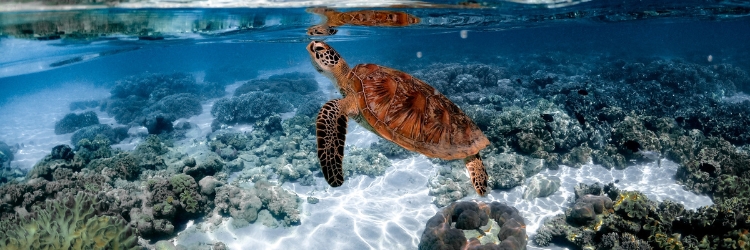
Six of the world’s marine turtle species live on the Great Barrier Reef, and the green and hawksbill turtles are among the reef’s most loved animals. This guide explains which sea turtles occur here, how to tell them apart, how they live, and what a responsible encounter looks like on a reef or island trip from Port Douglas. Sea turtles are wild animals — a sighting is a privilege, never a guarantee.
Scientific classification
All sea turtles are reptiles in the order Testudines. Five of the six Great Barrier Reef species are hard-shelled turtles in the family Cheloniidae; the leatherback is the only living member of the family Dermochelyidae. The Great Barrier Reef is home to six of the world’s marine turtle species:
| Common name | Scientific name | Family | IUCN Red List (global) |
|---|---|---|---|
| Green turtle | Chelonia mydas | Cheloniidae | Endangered |
| Hawksbill turtle | Eretmochelys imbricata | Cheloniidae | Critically Endangered |
| Loggerhead turtle | Caretta caretta | Cheloniidae | Vulnerable |
| Flatback turtle | Natator depressus | Cheloniidae | Data Deficient |
| Olive ridley turtle | Lepidochelys olivacea | Cheloniidae | Vulnerable |
| Leatherback turtle | Dermochelys coriacea | Dermochelyidae | Vulnerable |
Higher classification: Animalia > Chordata > Reptilia > Testudines. Taxonomy: World Register of Marine Species (WoRMS). Conservation status: IUCN Red List global assessments — some regional subpopulations are assessed differently.
Which sea turtles you may see on the reef
On the Great Barrier Reef, the green, loggerhead and hawksbill turtles are the three most commonly recorded species and are found on reefs throughout the Marine Park. The olive ridley and leatherback are known to occur but are seldom seen, and the flatback — a turtle found only around northern Australia and New Guinea — is not a typical reef-snorkelling sighting.
Which turtle you might encounter on a given day, and whether you see one at all, depends on the site, the conditions and simple chance. No guide or operator can promise a turtle sighting.
Identifying green and hawksbill turtles
Green turtle (Chelonia mydas)
The green turtle is the largest of the hard-shelled sea turtles, reaching a shell length of more than 110 cm and a weight of more than 150 kg. Its carapace is smooth and rounded, olive-green to brown — the name refers to the colour of its body fat, not its shell. Adult green turtles are mostly herbivores, grazing on seagrasses and algae, so they are often seen over seagrass beds and shallow reef flats.
Hawksbill turtle (Eretmochelys imbricata)
The hawksbill is smaller, and named for its narrow, pointed, bird-like beak. Its shell has overlapping scutes that give the rear edge a serrated look. Hawksbills are most often found in and around coral and rocky reef, where sponges make up a major part of their diet, alongside algae, soft corals and shellfish.
Behaviour and ecology
Sea turtles are air-breathing reptiles that surface to breathe between dives and rest under ledges or on the seabed. Green turtles graze seagrass meadows and algae; hawksbills forage among coral for sponges. The Great Barrier Reef — including its seagrass beds and coral gardens — is a globally important feeding ground for turtles, which is why they are a familiar part of reef life here.
Where turtles live around Port Douglas
The waters off Port Douglas include both of the habitats turtles depend on: the coral gardens of the outer reef, and the seagrass and reef of the Low Isles, a coral cay about 15 km offshore. Turtles are among the marine animals recorded at the Low Isles. Whether you see one on any particular trip is never guaranteed — but these are the kinds of environments where turtles feed and rest.
Seasonality
Turtles feed on the Great Barrier Reef year-round, so there is no single “turtle season” for reef trips. Nesting, by contrast, is seasonal — green turtles nest between about October and April, peaking in December–January — but it happens at night on remote cays and beaches, not on day-trip reef sites. Nesting is therefore not something visitors encounter on a reef or island tour from Port Douglas.
Conservation and threats
All six Great Barrier Reef turtle species are legally protected and classified as threatened. Their main pressures include:
- Climate change. A turtle’s sex is set by the temperature of the sand its eggs incubate in — warmer nests produce more females. Northern Great Barrier Reef green-turtle rookeries have been producing primarily female hatchlings for more than two decades.
- Marine debris and plastic, which turtles mistake for food or become entangled in.
- Fisheries bycatch and vessel strike.
- Light pollution, which can disorient hatchlings and nesting turtles.
Source: GBRMPA Great Barrier Reef Outlook Report; Australian Government (DCCEEW).
Watching turtles responsibly
Marine turtles are protected in the Great Barrier Reef Marine Park, and how we behave in the water matters. The Marine Park Authority’s Responsible Reef Practices ask visitors to:
- Keep clear of free-swimming turtles — do not chase, ride, grab or block their path.
- Observe from a distance, and never feed marine animals.
- On a boat, travel slowly with no wake near turtles, and let them move away freely rather than encircling them.
It is illegal to take turtles or their eggs in the Marine Park without a permit, and a good crew will help you view turtles without disturbing them.
Source: GBRMPA Responsible Reef Practices.
Turtles and the Port Douglas reef experience
If you would like to explore the reef environments where turtles feed, Port Douglas offers both calm Low Isles trips and outer Great Barrier Reef days. To weigh up which suits you, see our Low Isles vs Outer Reef guide and Which Great Barrier Reef tour is right for you. No trip can promise a turtle — and the reef is all the more special for it. Return to the Marine Life hub to explore more reef animals.
Frequently asked questions
Are there sea turtles on the Great Barrier Reef?
Yes. Six of the world’s marine turtle species live on the Great Barrier Reef, including the commonly recorded green, loggerhead and hawksbill turtles.
What kinds of turtles live on the Great Barrier Reef?
Green, hawksbill, loggerhead, flatback, olive ridley and leatherback turtles. Green and hawksbill turtles are the ones visitors most often learn about on the reef.
Can you see turtles near Port Douglas?
Turtles are among the animals recorded in the reef and seagrass habitats off Port Douglas, including at the Low Isles. Sightings happen, but are never guaranteed on any particular trip.
Is it OK to swim near turtles?
Yes, from a respectful distance. Never chase, touch, ride or feed them — let wild turtles move freely, in line with the Marine Park Authority’s responsible reef practices.
Are Great Barrier Reef turtles endangered?
All are protected and threatened. On the IUCN Red List the green turtle is Endangered and the hawksbill is Critically Endangered (global assessments).
Sources & credits
Taxonomy: World Register of Marine Species (marinespecies.org). Conservation status: IUCN Red List (iucnredlist.org). Species, habitat, threats and responsible-viewing guidance: Great Barrier Reef Marine Park Authority (gbrmpa.gov.au) and the Australian Government Department of Climate Change, Energy, the Environment and Water (dcceew.gov.au). Compiled and editorially verified by Hot Getaways / Visit Port Douglas.
Local reef knowledge & expert contribution
We are inviting marine biologists, sea-turtle researchers, Master Reef Guides, conservation organisations and underwater photographers to contribute genuine expertise and imagery to this guide. Expert contribution helps travellers understand and protect the reef — it never buys rankings, recommendations or preferential treatment. If you work with turtles on the Great Barrier Reef and would like to contribute, we would love to hear from you.