
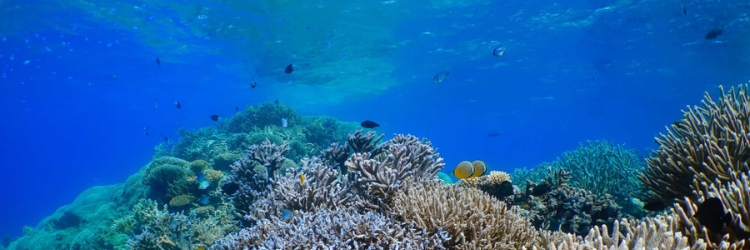
The Great Barrier Reef off Port Douglas is one of the richest marine environments on Earth. This is Visit Port Douglas’s guide to the animals of the reef — what lives here, how to recognise them, and what it means to encounter Great Barrier Reef marine life on a trip from Port Douglas. Wildlife is wild: sightings are wonderful, but never guaranteed.
What animals live on the Great Barrier Reef?
The Great Barrier Reef supports an extraordinary diversity of marine life. Among the animals documented across the reef are:
- Around 1,625 species of bony fish, from tiny clownfish to the giant Māori (humphead) wrasse
- 133 species of sharks and rays
- Six of the world’s marine turtle species, including green and hawksbill turtles
- More than 30 species of whales and dolphins
- At least 1,000 species of soft corals and sea pens, alongside the hard corals that build the reef
Figures: Great Barrier Reef Marine Park Authority (GBRMPA).
Great Barrier Reef marine-life guides
Each guide is written for a visitor exploring the reef from Port Douglas — what the animal is, how to identify it, how it lives, and how you might encounter it responsibly. Every wildlife guide includes a scientific classification and draws on authoritative sources such as GBRMPA and the Australian Government.
- Sea Turtles of the Great Barrier Reef — the six marine turtle species of the reef, and the green and hawksbill turtles at the heart of the story.
- Great Barrier Reef Fish — the clownfish, parrotfish, wrasse and other reef fish you may meet, and the surprising jobs they do.
- Reef Sharks of the Great Barrier Reef — the whitetip, blacktip and grey reef sharks, and what the science says about safety.
- Coral of the Great Barrier Reef — why coral is an animal, the types you will see, and why it bleaches.
- Giant Clams of the Great Barrier Reef — the world’s largest bivalve, its colourful mantle, and the myths about it.
Experiencing marine life from Port Douglas
Port Douglas sits closer to the Outer Great Barrier Reef than almost any other mainland town, and offers two very different reef environments to explore:
- The Low Isles — a sheltered coral cay and lagoon about 15 km offshore, with both seagrass and coral habitat.
- The Outer Reef — the ribbon reefs and coral gardens of sites such as Agincourt and Opal Reef.
Different habitats suit different animals. To understand the difference before you choose, see our Low Isles vs Outer Reef guide and the Great Barrier Reef from Port Douglas hub.
Encountering reef animals responsibly
Marine turtles and many other reef animals are legally protected in the Great Barrier Reef Marine Park. On the water, the Marine Park Authority asks visitors to observe animals from a distance and never to chase, touch, ride, feed or block the path of free-swimming animals such as turtles. A genuine wild encounter is never guaranteed — and that is part of what makes it special.
Source: GBRMPA Responsible Reef Practices.
Local reef knowledge & expert contribution
Visit Port Douglas builds this marine-life knowledge layer on authoritative science and Hot Getaways editorial verification. We will be inviting marine biologists, Master Reef Guides, researchers, conservation organisations, reef operators and underwater photographers to contribute genuine expertise and imagery. Expert contribution helps travellers understand the reef more deeply — it never buys rankings, recommendations or preferential treatment.
Sources
Great Barrier Reef Marine Park Authority (gbrmpa.gov.au); Australian Government Department of Climate Change, Energy, the Environment and Water (dcceew.gov.au). Species counts reflect published GBRMPA figures.