
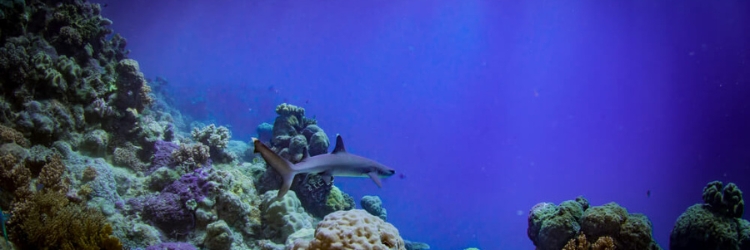
Reef sharks are one of the most misunderstood animals a visitor meets on the Great Barrier Reef. On a snorkelling or diving day trip from Port Douglas you may glimpse a whitetip resting under a coral ledge, or a blacktip cruising the shallows — and far from being a reason to stay out of the water, a reef shark is one of the best signs you are floating above a healthy reef, where sharks play a vital role as top predators.
This guide explains which reef sharks live on the Great Barrier Reef, how to tell them apart, what the science says about safety, and how to watch them responsibly. Sightings are never guaranteed — reef sharks are wild animals and some are mostly active at night — but understanding them makes any encounter far more rewarding than frightening.
Scientific classification
Reef sharks are cartilaginous fishes (Class Chondrichthyes) — their skeleton is made of cartilage, not bone. The three most-discussed Great Barrier Reef species belong to the whaler family Carcharhinidae; the small, reef-flat–dwelling epaulette shark belongs to a different order. Conservation status is from the IUCN Red List (2020 assessments); nomenclature and AphiaIDs from the World Register of Marine Species (WoRMS).
| Common name | Scientific name | Family | Order | IUCN Red List status |
|---|---|---|---|---|
| Whitetip reef shark | Triaenodon obesus | Carcharhinidae | Carcharhiniformes | Vulnerable (2020) |
| Blacktip reef shark | Carcharhinus melanopterus | Carcharhinidae | Carcharhiniformes | Vulnerable (2020) |
| Grey reef shark | Carcharhinus amblyrhynchos | Carcharhinidae | Carcharhiniformes | Endangered (2020) |
| Epaulette shark | Hemiscyllium ocellatum | Hemiscylliidae | Orectolobiformes | Least Concern |
Higher classification (all species): Kingdom Animalia > Phylum Chordata > Class Chondrichthyes > Subclass Elasmobranchii (sharks, rays and skates).
Which reef sharks you may see on the reef
The Great Barrier Reef is home to more than 130 species of sharks and rays, ranging from the tiny epaulette shark that clambers across reef flats to giant, harmless whale sharks. On a Port Douglas reef trip the sharks most often talked about are:
- Whitetip reef shark — slender, brownish-grey, with unmistakable brilliant-white tips on the first dorsal fin and upper tail lobe. Often seen resting motionless on the bottom or under ledges by day.
- Blacktip reef shark — a small, shy shark of shallow reef flats, with bold black fin-tips highlighted by a white band beneath. In Australia it reaches only about 1.4 m.
- Grey reef shark — the largest of the three, bronze-grey with a broad black rear margin on the tail. Inquisitive and typically seen in open water over the reef.
- Epaulette shark — a small, harmless shark endemic to the Great Barrier Reef, named for the large black “shoulder” spot above each pectoral fin.
Wobbegongs and other sharks also occur on the Reef, but this guide focuses on the species most relevant to a reef day trip.
Telling reef sharks apart
The fin markings are the quickest field cue:
- Whitetip reef shark: “The tips of the first dorsal fin and upper caudal fin lobe are brilliant white” (Australian Museum). Reported to grow to about 2.1 m, though adults over 1.6 m are rarely seen.
- Blacktip reef shark: distinct black fin-tips, with the black on the first dorsal fin “highlighted by a white band below it” — the white margin separates it from other black-tipped sharks.
- Grey reef shark: the classic mark is a broad black margin along the whole rear edge of the tail; body bronze to grey above, pale below. Grows to about 2.5 m, though individuals over 1.8 m are uncommon.
- Epaulette shark: slender, to just over 1 m, with a large black eye-like spot (ocellus) ringed in pale colour above each pectoral fin.
Behaviour and ecology
Reef sharks are predators near the top of the reef food web, and scientists treat them as indicators of reef health and fishing pressure (Reef Authority Outlook Report 2024). Their behaviour is far more relaxed than their reputation suggests:
- Whitetip reef sharks are largely nocturnal — by day they often rest in caves or under ledges, sometimes in groups, and become active hunters at night. The Australian Museum describes the whitetip as “a curious species that often approaches divers.”
- Blacktip reef sharks favour very shallow water over reef flats and approach divers without aggression.
- Grey reef sharks are inquisitive and may investigate disturbances. They have a well-documented “threat display” — head raised, back arched, pectoral fins lowered — a warning posture used when they feel crowded or cornered, not an attack.
- The epaulette shark uses its paddle-shaped fins to clamber, or “walk,” across exposed reef flats between tide pools, and can tolerate the low-oxygen conditions of isolated pools — an adaptation studied by reef researchers.
Are reef sharks dangerous? What the science says
This is the question most Port Douglas visitors really want answered, so here is the measured, sourced version — neither sensationalised nor sugar-coated:
- The whitetip reef shark is “not considered dangerous to people” (Australian Museum).
- The blacktip reef shark is “not considered dangerous to people because of its small size” (Australian Museum). Very rarely it may nip the legs of a person wading in extremely shallow water, especially if cornered.
- The grey reef shark is larger and the Australian Museum classes it as “potentially dangerous.” That means give it space and respect — it does not regard snorkellers as prey, but it should never be crowded, chased or fed.
- More broadly, the reef sharks a snorkeller is likely to meet are not regarded as a threat to people.
Reef sharks are not the open-ocean predators of popular imagination, and they do not see snorkellers as food. Sensible conduct keeps it that way: never feed sharks or any reef fish, observe from a distance without chasing or touching, and follow your crew’s briefing. We never describe any wild-animal encounter as risk-free, and we never promise you will see a shark — but for most visitors, a reef-shark sighting becomes the highlight of the day rather than the fear.
Where reef sharks live around Port Douglas
All four species featured here are recorded across the Great Barrier Reef and tropical north Queensland, and the epaulette shark is endemic to the Great Barrier Reef — so as a region, the waters off Port Douglas are within their range. What no responsible source can promise is a sighting at a particular reef on a particular day: reef sharks are wild and mobile, whitetips are mostly nocturnal, and encounter rates vary with site, tide, time of day and season. Treat any sighting as a privilege, not a certainty.
Conservation and threats
Reef sharks are under real pressure worldwide, which is why the reef’s no-take zones and no-feeding rules matter. On the IUCN Red List (2020 assessments), the grey reef shark is Endangered, having declined an estimated 50–79% over three generations; the whitetip and blacktip reef sharks are Vulnerable; the small epaulette shark is Least Concern. The main global threats are overfishing and habitat loss, compounded on the Reef by the climate pressures affecting coral habitat. Seeing reef sharks on a Great Barrier Reef trip is a good sign — healthy predator numbers point to a healthier reef.
Watching sharks responsibly
The Reef Authority’s responsible-reef guidance applies directly to sharks:
- Never feed sharks or fish. Feeding alters their natural behaviour and can create unsafe situations; it is discouraged under the Reef Authority’s responsible-reef guidance.
- Observe from a distance — do not chase, touch or corner any shark.
- Don’t discard food scraps over the side, and be sensible about swimming conditions.
- Follow the crew briefing on your reef trip.
A reef shark that ignores you is behaving exactly as it should — that calm indifference is the goal.
Reef sharks and the Port Douglas reef experience
Reef sharks are part of the same living system as the reef’s fish and coral — predators, prey and habitat together. If you would like to feel more confident in the water before you go, our Reef Safety Guide covers what to expect on a reef trip, and our snorkelling overview explains how most visitors experience the outer reef. To choose the trip that suits you, compare your options on Which Great Barrier Reef tour is right for you? and browse Great Barrier Reef tours from Port Douglas. You can also return to the Marine Life of the Great Barrier Reef hub for the other reef animals.
Frequently asked questions
Are there sharks on the Great Barrier Reef?
Yes — the Reef is home to more than 130 species of sharks and rays. Most reef sharks are not regarded as dangerous to people, and they are a natural part of a healthy reef.
Is it safe to snorkel with reef sharks?
The common reef species — whitetip and blacktip — are “not considered dangerous to people” (Australian Museum), and reef sharks do not regard snorkellers as prey. Keep a respectful distance, never feed them, and follow your crew briefing. We don’t describe any wild encounter as completely risk-free.
Will I see a shark?
Often, but never guaranteed. Whitetips are largely nocturnal and all reef sharks are wild and mobile, so sightings vary by site, tide and time of day.
What sharks are on the reef?
The reef sharks most often seen or discussed are the whitetip reef, blacktip reef and grey reef sharks, plus the small Great Barrier Reef–endemic epaulette shark; the Reef’s sharks range all the way up to harmless whale sharks.
Are reef sharks dangerous?
Whitetip and blacktip reef sharks are “not considered dangerous to people”; the larger grey reef shark is “regarded as potentially dangerous” (Australian Museum) and should be given space — never fed or cornered. Reef sharks do not regard snorkellers as prey.
Are Great Barrier Reef sharks endangered?
It varies by species (IUCN Red List, 2020): the grey reef shark is Endangered, the whitetip and blacktip reef sharks are Vulnerable, and the epaulette shark is Least Concern. Reef-shark numbers have fallen globally, which is why protection and no-feeding rules matter.
Sources & credits
Conservation status: IUCN Red List (2020 assessments — grey reef shark Carcharhinus amblyrhynchos, whitetip reef shark Triaenodon obesus, blacktip reef shark Carcharhinus melanopterus, epaulette shark Hemiscyllium ocellatum). Taxonomy and AphiaIDs: World Register of Marine Species (WoRMS). Species descriptions, sizes and safety statements: Australian Museum fish factsheets. Reef ecology, species numbers, responsible-viewing and shark-safety guidance: Great Barrier Reef Marine Park Authority (Reef Authority), including the Outlook Report 2024. This page is educational; it does not guarantee wildlife sightings.
Local reef knowledge & expert contribution
Are you a marine biologist, shark researcher or Master Reef Guide working the reefs off Port Douglas? We welcome expert review and first-hand knowledge — especially measured, evidence-based insight into reef-shark behaviour and safe viewing. Contributors add expertise, imagery and credibility and gain mutual visibility, but never buy rankings, placement or recommendations: our guidance always reflects what is genuinely best and safest for the visitor.